
Cave Best of Series
Want to read and practice the best of ancient Greek literature?
Learn and grow with one of the following Cave Best of Series books.
"I just wanted to say . . . I really love your books! . . . You have really helped me develop myself with your books." - Manuel

$15.95

$15.95

Take the quiz covering ancient Greek literature and philosophy here.

$15.95

$15.95
$15.95

$15.95


Want to know more about the Cave Best of Series? To learn more, go here.
Want to know more about each Cave Best of Series book? Want to read a selection from each book? Scroll below here.
Take the quiz covering the best of ancient Greek literature and philosophy here.
It's QUIZ time! Ancient Greek Literature Quiz
Try to answer the following multiple-choice questions!
Look for other quiz questions below.
What to do
Choose the best answer for the 15 questions found here and toward the bottom of this page (here).
You'll find the correct answers in the "Quiz Answers" section below (here).
Quiz Question 1
Who wrote the Iliad and Odyssey? Who wrote the Histories? Who wrote the Enneads?
A. Hesiod. Thucydides. Plato.
B. Sappho of Lesbos. Xenophon. Aristotle.
C. Callimachus. Diodorus Siculus. Zeno of Citium.
D. Homer. Herodotus. Plotinus.
E. None of the above.
You'll find more quiz questions below here.
The Best of Homer's Iliad
Think you know about the Iliad of Homer?
Try to answer the quiz questions about the Iliad found below! Start here.

The Best of Homer's Iliad
eBook version
$9.95
Coming soon.

Here's what you'll get in reading
The Best of Homer's Iliad
The Best of Homer's Iliad presents the best of Homer's great epic poem in translated and narrative summary form.
If you've never read the Iliad, and you don't know how much time you'd like to invest in doing so, then this version is for you. You'll get the best parts of the poem in translation (about one-half) and a narrative summary of the rest.
In addition to the poem, there's an informative introduction exploring "Why We Should Care about Homer," “Basic Facts about Homer,” and “The Big Themes and Ideas of the Iliad."
After reading the poem, you'll find, “Other Matters of Interest Related to Homer,” including “The Cast of Gods and Men,” a map of “The Warring Sides of the Trojan War,” a day-by-day timeline of the Iliad, a glossary of Homeric Greek terms, and suggestions for further reading.
Finally, there is a section offering “Points of Wisdom & Ways of Practice”—a chance to apply and practice Homeric wisdom to your own life.
Why should you want to read Homer's Iliad ?
Go back a few thousand years and Homer’s Iliad was a perennial blockbuster. That’s because Homer himself was the one everyone turned to for entertainment, education, and inspiration. A scholar once claimed that “if a Greek owned any books—that is, papyrus rolls—he was almost as likely to own the Iliad and the Odyssey as anything from the rest of Greek literature.” Homer was Greece’s chief educator and coach; he shaped Greek feelings, thoughts, and behavior.
Homer is celebrated for the Iliad, a sweeping epic poem that touches on everything that matters most to us humans. There’s heroic anger and suffering. There’s love, friendship, and enmity. Most of all, there’s the mad quest for happiness, for the good and noble life.
What now? Strap on your well-fitting greaves, fix your bronze helmet on your head, pick up your shield, spear, and a goatskin of water, and prepare to step into an ancient world that is stirringly wonderful and horrifying in turn. Welcome to Homer’s Iliad!
Here's a selection from the very beginning of The Best of Homer's Iliad
WRATH! SING, GODDESS, about the destructive wrath of Achilles, the son of Peleus—the anger that caused so much pain and suffering among the Achaeans. Who could possibly measure it all?
His anger sent many strong souls—the breath-like phantoms of men—down to the dark halls of Hades, while above, their fallen bodies became food for wild dogs and scavenging birds.
In this way Zeus’ plan advanced to the very end.
Sing from the exact moment when the lord of men Agamemnon and godlike Achilles stood apart quarrelling with each other. Reveal the god that urged them forward, face to mighty face, in strife and disputation.
Ah—it was Apollo, the son of Leto and Zeus. He was angry with lord Agamemnon. So he fired a wicked plague down upon the army, and the men were dying a violent death all because Agamemnon refused to honor Apollo’s priest Chryses.
Now Chryses had come to the Achaean ships to free his daughter. He brought with him a whole load of treasure for ransom and carried in his right hand the golden scepter of far-shooting Apollo. Standing there, he begged the Achaeans to release his prized daughter, but most of all, he entreated the two sons of Atreus, Agamemnon and Menelaus, the army’s commanders.
“Sons of Atreus and all you other well-greaved Achaeans,” he called out, “may the gods who dwell upon Olympus allow you to sack the great city of Priam. And later, may you safely come to your homes. In return, all I ask is that you release my dear child—that you accept this ransom for her out of respect for Zeus’ son Apollo, who strikes from afar.”
Hearing this, all the Achaeans shouted and clapped their hands in approval, giving their assent to Chryses. They wished to respect the priest of Apollo and accept his shining payment.
But not the son of Atreus! No, the proposal didn’t please Agamemnon at all. Instead, he wickedly sent off Chryses by means of this cruel speech:
“Old man,” he said, “don’t let me find you hanging around our ships. Hear me when I command you to never come to our camp again. If you do, the god’s golden scepter will not protect you. Listen to me. I will not let her go! No, your prized daughter will grow old in my house at Argos far away from her own home. There she will busy herself by working the loom and by visiting my bed. So go! And if you wish to return home safely, alive and well, then do not any longer provoke me to anger.”
That’s what lord Agamemnon said. And hearing him, the old man feared the leader and obeyed his command.
Chryses walked off and silently ambled along the shore of the loud and roaring sea, quietly praying to Apollo. “Hear me,” he cried, “god of the silver bow, you who protect the port city of Chryse and holy Cilla, and you who mightily rule Tenedos. Hear me Sminthian god! If I have ever pleased you in building up a temple or in offering the burnt thighbones of great bulls or goats wrapped in layers of fat, then may the Danaans pay for my tears with your deadly arrows tipped with disease and suffering!”
To read more, go to The Best of Homer's Iliad in the Cave Library.
What others have said -
"Homer's book is a delightful treasure. All that he has touched has turned to gold . . . Everywhere he entertains and never grows tired." - Nicholas Boileau-Despreaux
"As Achilles is among warriors, so Homer is beyond all comparison among poets." - Quintilian
The Best of Homer's Odyssey
Think you know about the Odyssey of Homer?
Try to answer the quiz questions about the Odyssey found below! Start here.

The Best of Homer's Odyssey
eBook version
$9.95
Coming soon.

Here's what you'll get in reading
The Best of Homer's Odyssey
The Best of Homer's Odyssey presents the best of Homer's great epic poem in translated and narrative summary form.
If you've never read the Odyssey, and you don't know how much time you'd like to invest in doing so, then this version is for you. You'll get the best parts of the poem in translation (about one-half) and a narrative summary of the rest.
In addition to the poem, there's an informative introduction exploring "Why We Should Care about Homer," “Basic Facts about Homer,” and “The Big Themes and Ideas of the Odyssey."
After reading the poem, you'll find toward the end of the book “Other Matters of Interest Related to Homer’s Odyssey,” which includes: “The Cast of Gods and Men”; maps depicting the journeys of Odysseus and Telemachus; a glossary of Homeric Greek terms; suggestions for further reading.
Finally, there is a section offering “Points of Wisdom & Ways of Practice”—a chance to apply Homeric wisdom to your own life and practice it.
Why should you want to read Homer's Odyssey ?
Go back a few thousand years and Homer’s Odyssey was a perennial blockbuster. That’s because Homer himself was the one everyone turned to for entertainment, education, and inspiration. A scholar once claimed that “if a Greek owned any books—that is, papyrus rolls—he was almost as likely to own the Iliad and the Odyssey as anything from the rest of Greek literature.” Homer was Greece’s chief educator and coach; he shaped Greek feelings, thoughts, and behavior.
Homer is celebrated today for the Odyssey, a sweeping epic poem that tells the story of Odysseus’ harrowing return home after the Trojan War and his epic battle against the suitors. The archetypal voyager, Odysseus endures countless heartaches and hardships during his journey home, confronting gods, monsters, and men, all out to harm him. He faces himself, as well—his desire to give up before reaching his goal.
What now? Drag your hollow ship into the wine-faced sea, raise the sail, and get ready to voyage into an ancient world full of monsters and gods, enemies and friends, strange lands and home. Welcome to Homer’s Odyssey !
Here's a selection from the very beginning of The Best of Homer's Odyssey
MAN—TELL ME, Muse, of the versatile man of many adventures, who wandered much after he had sacked the holy town of Troy. He visited many cities and knew the mind and thoughts of many men. When he was out to sea, he suffered much pain in his spirit in the attempt to save his own life and win his comrades their return home. Whatever he did, though, he could not save his men, for they were destroyed through their own recklessness by eating the cattle of Helios, the sun god Hyperion. The fools! So the god snatched away the day of their return. From whatever source you may know these things, goddess, daughter of Zeus, speak to us of these.
So then, all the rest of them, the ones who had escaped utter destruction, were at home having fled both the dangers of the war and the sea. That man alone, though he was longing to return home and for his wife, was detained by the queenly goddess Calypso, who kept him in her hollow caves and wanted to marry him. But as the years revolved one after the other, there came a day when the gods all agreed it was his destined time to return home to Ithaca. Yet even then his troubles were not over. When home among his dear people, he suffered more. Nevertheless, all the gods had now begun to pity him—all except for Poseidon, who still hotly raged against him without ceasing until godlike Odysseus came to his own land.
Now Poseidon had gone off to the Ethiopians, who are at the world’s end and live far apart from other men. They are divided in two. Half of them live where the Sun sets, and the other half live where he rises. He had gone to them to accept a hecatomb of bulls and rams. And seated, he was delighting himself at the feast.
The other gods were assembled together in the great halls of Olympian Zeus. And among them, the father of men and gods spoke first. He had in mind the nobleman Aegisthus, who had been killed by far-famed Orestes, the son of Agamemnon. And so, thinking about this, he addressed the other immortals:
“How shameful it is that the mortals even now blame the gods! From us, they say, come all sorts of bad things. But it is through their own recklessness that they have sorrows beyond those that are fated. . . ."
To read more, go to The Best of Homer's Odyssey in the Cave Library.
What others have said -
"When Aristodemus was asked who he admired for wisdom, he told Socrates: 'In epic poetry, Homer comes first.'" - Xenophon
"I rank Homer among the oldest and wisest of the poets." - Aeschines
The Best of Hesiod's Theogony & Works and Days
Think you know about the Theogony and the Works and Days of Hesiod?
Try to answer the quiz questions about the Theogony and the Works and Days found below! Start here.

Here's what you'll get in reading
The Best of Hesiod's Theogony & Works and Days
Have you ever read the ancient Greek poet Hesiod?
Hesiod is celebrated for two epic poems—the Theogony and the Works and Days. Both poems were immensely important to the ancient Greeks.
The Theogony recounts the birth of the gods from “the very beginning” and the progressive ordering of the cosmos. Beginning with Chaos, Desire (Eros), and Earth (Gaia), we witness Sky (Ouranos) and Kronos violently wield power until Zeus forcibly takes over after the great Titanomachy (the battle with the Titans) and justly allots the whole cosmos.
The Works and Days is a book of advice—about how things are and why they are the way they are; about how to approach work and the hardships of life; about justice and injustice; about the road to success and wealth; and lastly, though doubtlessly there’s more, about the cycle of work to be done throughout the year and the character of and activities for each day of the month.
In addition to Hesiod’s epic poems, The Best of Hesiod’s Theogony & Works and Days begins with an informative introduction presenting, in addition to other points, “Why Should We Care about Hesiod?” “Basic Facts about Hesiod,” and “The Big Themes and Ideas of the Theogony & the Works and Days.”
After reading Hesiod’s poems, you’ll find “Other Matters of Interest Related to Hesiod,” including a “Cast of Gods and Men,” genealogical charts, maps of Hesiod’s world and cosmos, an imaginary excursion to Hesiod’s cosmos, a table identifying “The Days from Zeus,” a glossary of pertinent Greek terms, summaries of the Theogony and the Works and Days, and suggestions for further reading.
Finally, there is a section offering, “Points of Wisdom & Ways of Practice”—a chance to apply Hesiodic wisdom to your own life and practice it.
What now? Strap on your felt-lined close-fitting oxhide boots and prepare to step into an ancient world that is bizarre and delightful in turn, as well as thought-provoking and full of good sense and counsel. Welcome to Hesiod’s cosmos and wisdom!
Coming soon.
Here's are two selections from The Best of Hesiod's Theogony & Works and Days
From the Theogony
LET US BEGIN to sing with the Helikonian Muses, the ones who live upon the great and sacred mountain—Mount Helikon.
It is there they dance together in a line on soft feet around the deep-blue spring and raised altar of Zeus, the mighty son of Kronos. They do this after they have bathed their delicate bodies in Permessos, or in Hippokrene, the Horse’s Spring, or sacred Olmeios. Then upon the heights of Helikon they perform their lovely moves that call upon desire, giving their feet to the dance. From there they urge one another into the night, and each night, hidden away by a thick mist, they walk together broadcasting their very beautiful voices in song.
They hymn aegis-bearing Zeus and queenly Argive Hera, the one who steps forward in golden sandals. They sing about the daughter of aegis-bearing Zeus, bright-eyed Athena, and about Phoebus Apollo and Artemis, the arrow-shooter. They laud Poseidon, who holds and shakes the Earth, and praise highly regarded Themis. And they adore many others—quick-glancing Aphrodite, golden-crowned Hebe, and beautiful Dione and Leto. . . .
One day the Muses taught Hesiod beautiful song while he was tending his sheep under sacred Helikon. Here is what the goddesses first said to me. . . .
To read more from the Theogony, go to the Cave Library.
From the Works and Days
PIERIAN MUSES, YOU who glorify through your songs, come here and with a hymn say something about Zeus, your own father. It is through him that mortal men are either named or not and known or not by the will of great Zeus. He easily makes a man strong and mighty, and just as easily he crushes his strength and might. He easily lays low the conspicuous man and raises high the one unknown. Dwelling in the uppermost house, high-thundering Zeus easily straightens out the crooked man and withers the arrogant.
Hear me, Zeus, you who watch and listen, and make decrees straight with justice. As for me, I will convey what is true—what is actual and real—to Perses.
So, there was not one kind of Strife (Eris), after all, but upon the earth there are two kinds of strife. The one is praised once a man comes to know her, while the other is found blameworthy. The spirit of each is quite different. The one, being cruel, multiplies evil war and battle. No mortal man loves her. Even so they honor the oppressive Strife by necessity, by the plans of the immortals.
But dark Night (Nyx) gave birth to the other Strife first. And Zeus, Kronos’ high-throned son, who dwells in the brightest and purest sky, planted her in the roots of the earth. She is much better for men. She rouses even the helpless man to work. Such a one will long for work when he sees a wealthy man hurrying to plow and plant and put his house in good order. And so . . .
To read more from the Works and Days, go to the Cave Library.

What others have said -
"Hesiod has proved to be one of the best counselors for human conduct." - Isocrates
"As for the ignorant person, let him hear the words of Hesiod. . . . The advice of Hesiod is good." - Aristotle
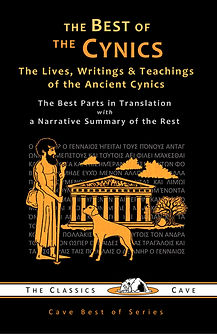
The Best of the Cynics
The Lives, Writings & Teachings of the Ancient Cynics
Think you know about the Cynics & Cynicism?
Try to answer the quiz questions about the Cynics & Cynicism found below! Start here.

The Best of the Cynics
eBook version
$9.95
Coming soon.

Here's what you'll get in reading
The Best of the Cynics
The Best of the Cynics presents most of what remains of the ancient Greek Cynics. But who were the Cynics? And what is Cynicism?
Cynicism is not what you think it is. It’s not something negative, pessimistic, or bitter—not the ancient sort, anyway. Not exactly.
Beginning with Antisthenes and Diogenes, the ancient Cynics and their philosophy influenced the Greek and Roman worlds for nearly a millennium. What they had to offer was a radical way of life. An intense practice. Theirs was a way to train in order to face the desires that plague us and endure the suffering we humans must inevitably encounter.
What did the Cynics hope to accomplish? They wished to live a life in accord with nature, a virtuous life, one characterized by self-control, self-sufficiency, and simplicity. They wanted to be free—to speak freely, to challenge conventions. They hoped to be as shameless as a dog—and yes, as happy as a dog, too.
Ancient Cynicism held out the possibility of a better life, a way to live well. But it wasn’t a life for the wavering or fainthearted. Rather, as they portrayed it, their path was a shortcut to the heights. Diogenes of Sinope put it this way: “I . . . chose the steep and troublesome path—for the man speeding on to happiness must go on even if it is through fire and sword.”
The Best of the Cynics presents most of what remains of the ancient Cynics—what they wrote and what others wrote about them. It begins with an informative introduction and ends with a ten-point Cynic “Plan of Life” and three exercises for practice, along with “Other Matters of Interest Related to the Cynics,” including a cast of significant Cynics, a map, a glossary of pertinent Greek terms, and suggestions for further reading.
If you are new to the Cynics and Cynicism, you will come away fully understanding what their philosophy and way of life was all about. If you are already familiar with them, we hope The Best of the Cynics will shed new light on what you know. If nothing else, you’ll see how the Cynics and their way of life are still relevant today.
Here's a selection from The Best of the Cynics
From Chapter Twelve, "The Letters of Diogenes of Sinope"
LETTER 7 To Hicetas: Do not be distressed, father, that I call myself a dog, and I clothe myself with a doubled over tattered cloak, and I carry a leather bag over my shoulders, and I have a staff in my hand. It is not fitting to be upset by such matters. Instead, be delighted that your son is content with little and that he is free from popular opinion, to which everyone, both the Greeks and barbarians, are enslaved. . . .
LETTER 12 To Crates, Do well: Whenever they hear about a shortcut leading to happiness, the many throw themselves at it just as we do with philosophy. But when they reach the path and see how difficult it is, they retreat, going back-wards, as if weak or sick. And rather than complaining about their own softness they find fault with our freedom from passion and suffering.
Well then, let them sleep with their pleasures as they are eager to do! For if they live this kind of life, then even greater hardship will befall them than those by which they slander us. And so, they are shamefully enslaved in every circumstance.
As for you, keep training just as you began, and earnestly set yourself in equal measure against both pleasure and hardship. . . . The one carries us off to shameful deeds, while the other, through fear, takes us away from that which is noble.
LETTER 30 To Hicetas, Do well: I came, Father, to Athens, and learning that Socrates’ associate was teaching about happiness, I went to him.
And he happened to be speaking about the paths that lead to happiness. He declared that there are two and not many paths—and that one is a shortcut and the other is long. It is up to us to choose which path we follow, he said.
When I heard this, I kept quiet. But when we went to him again the next day, I called on him to show to us the paths.
Quite readily, he stood from his chair and led us into the city, straight through it to the acropolis. And when we had drawn near, he showed us two paths leading upward. The one is short, steep and troublesome; the other is long, smooth and easy.
When he brought us down, he said, “Such are the paths leading up to the acropolis. And such are the paths leading to happiness. Choose the path as you wish, and I will guide you.”
While the others, who were struck with fear at the troublesome and steep nature of the one path, called on him to lead them along the long and smooth one, I, superior to the hardships, chose the steep and troublesome path—for the man speeding on to happiness must go on even if it is through fire and sword.
To read more of the Cynics, go to The Best of the Cynics in the Cave Library.
What others have said -
"Thank you for your wonderful book, The Best of the Cynics. It is the first book I found on the Cynic philosophy or way of life. It is very informative, inspiring, and the layout is awesome." - Fabian
"I have a shelf full of books on the Greek Cynics. . . . I would suggest that yours is the best of them. [Yours] stands head and shoulders above the rest." - Len
"The Cynics claimed to possess wisdom. . . . Did they not know the road to happiness?" - Farrand Sayre
"Cynicism is a kind of philosophy. . . . It is a match for the most excellent philosophy." - Julian the Roman emperor
The Best of Epicurus
The Life, Writings & Teachings of Epicurus the Greek Philosopher
Think you know about Epicurus & Epicureanism?
Try to answer the quiz questions about Epicurus & Epicureanism found below! Start here.

The Best of Epicurus
eBook version
$9.95
Coming soon.

Here's what you'll get in reading
The Best of Epicurus
If you’d like to learn about the ancient Greek philosopher Epicurus and Epicureanism, then you'll want to grab a copy of The Best of Epicurus.
Who was Epicurus? And what is Epicureanism?
Contrary to what the modern term “epicurean” implies, ancient Greek Epicureanism was anything but “fond of indulgence and devoted to sensual enjoyment.” In this modern sense, Epicurus himself (c. 341-271 BC) was no “epicure.” Rather, fan of a simple diet of barley cakes and water, he boasted that if he had these, he could compete with Zeus himself in terms of bliss.
It has been said that Epicurus’ “manner of life was much more like that of an abstemious monk.” It’s true. Epicurus proposed a deliberate way of life that would help men and women live well and be happy. The Epicurean path influenced countless individuals in the ancient Greek and Roman worlds for nearly a millennium. It is The Classics Cave’s hope that we may still benefit from Epicurus and his wisdom today.
What is the Epicurean way of life? It is one centered on knowing well in order to live well. That—living well and being happy—is the goal. The means of achieving the goal are fairly straightforward however hard to practice. They are seeking wisdom. Sticking with the facts of reality. Desiring well. Enduring pain (if need be). Striving for self-sufficiency. Living simply. Cultivating the virtues. Nurturing friendship. With these, the long night of dread and anxiety begins to transition as the bright sun of tranquility appears.
The Best of Epicurus presents Epicurus’ own writings and teachings, as well as much of what remains about his life and philosophy from antiquity. It begins with an informative introduction, which, aside from explaining why we should care about Epicurus and the basic facts we should know about him, delves deeply into the big themes and ideas of his philosophy and way of life.
The Best of Epicurus ends with a twelve-point Epicurean “Plan of Life,” “Points of Wisdom from Epicurus,” and three workbook or journal-like exercises for practice, along with “Other Matters of Interest Related to Epicurus,” including a cast of significant ancient Epicureans, two maps, summaries of his major works, a glossary of pertinent Greek terms, and suggestions for further reading.
If you are new to Epicurus and Epicureanism, you will come away fully understanding what this school of philosophy and way of life was all about. If you are already familiar with the school, we hope The Best of Epicurus will shed new light on what you know. If nothing else, you’ll see how Epicurus and his philosophy are still relevant today.
Here's a selection from The Best of Epicurus
From Chapter 5, “On Living Well & Happily: The Letter to Meneoceus”
EPICURUS TO MENOECEUS, greeting.
Let no one put off studying philosophy when he is young, nor become weary of it when he is old, for no age is too early or too late for the health of the soul. To suggest that the time for studying philosophy has not yet come or that it is long gone is like saying that it is too early or too late for happiness. Therefore, both the young and the old should seek wisdom. The latter should do philosophy so that, even though he is old, he may be young in good things through the delight of what has been, whereas the former should do philosophy so that, while he is still young, he may at the same time be old through his lack of fear of what is destined to come. So, we must practice those things that produce happiness since if happiness is present, we possess everything, and if it is not, we do everything to acquire it.
Do and practice those things that I have continually recommended to you, taking them to be the basic elements of living well. . . .
We must consider that of the desires, some are natural, and some are groundless.
Of the natural desires, some are necessary, and some are merely natural.
And of the necessary desires, some are necessary for happiness, some for freeing the body from disturbance, and some for living itself.
He who has a firm understanding of these things knows how to direct every choice and every avoidance toward securing bodily health and mental tranquility since this is the goal of a blessedly happy life. Everything we do is for the sake of being free from pain and from fear. The soul’s storm scatters as soon as we achieve this condition. Then we have no need to go around looking for anything that is lacking or seeking something else by which the good of the soul and the good of the body will be fulfilled.
We have the need for pleasure only when we feel pain due to the absence of pleasure. When we feel no pain, however, there is no need for pleasure. For this reason, we say that pleasure is the beginning point and goal of living happily. We recognize that pleasure is our first good, present at birth, and that it is the beginning point of every choice and avoidance. We resort to pleasure when we use feeling as the measure for judging every good.
Even though pleasure is our first and inborn good, we nevertheless do not choose every pleasure. Rather, we oftentimes forgo many pleasures when a greater annoyance will follow from choosing them. And oftentimes we acknowledge that many pains are better than many pleasures when an even greater pleasure follows from patiently enduring these pains for a long period of time. And so, even though every pleasure is naturally good and fitting, not every pleasure is to be chosen. In the same way, even though every pain is bad, not every pain is always to be avoided. To be sure, we may aptly judge every case by measuring one feeling in comparison with the other and taking a look at the advantages and disadvantages of both sides. Sometimes we treat a good thing as though it is bad. On the other hand, sometimes we treat a bad thing as though it is good.
We regard self-sufficiency as a great good. This is not so that we may enjoy just a little in every case, but so that when things are scarce, we may nevertheless be satisfied with little, genuinely persuaded that the ones who derive the greatest pleasure from luxury are the ones who need it the least, and that everything natural is easy to get, but whatever is groundless is hard.
Simple food gives just as much pleasure as rich food does as soon as the hunger pains are gone. A barley cake and water offer the highest possible pleasure when they are given to a hungry man. Getting used to simple and inexpensive food, therefore, aids the health of a man and enables him to perform the necessary requirements of life with resolution. Not only that, but such a habit better disposes us for when we encounter extravagant fare now and again, and makes us fearless in the face of fortune.
So then, when we say that pleasure is the beginning point and goal of life, we do not mean the pleasures of decadent men or the pleasures of sensuality, as some ignorant persons believe, or those who do not agree with us, or those who have willfully misrepresented our position. Rather, by pleasure we mean the absence of pain in the body and of trouble in the soul. A pleasant life is not produced by stringing together one drinking party after another, or by having sex with young boys or women, or by enjoying fish and other delicacies set on a luxurious table. Instead, it is produced by sober reasoning that examines what is responsible for every choice and avoidance, and expels those beliefs by which the greatest confusion lays hold of the soul.
To read more from Epicurus, go to The Best of Epicurus in the Cave Library.
What others have said -
"I finished The Best of Epicurus today and loved it. I enjoy the format of presenting all the important concepts in a readable way and encouraging readers to reflect on and apply this to their own lives." - John
"O Epicurus! You who were the first to raise so bright a light from so great a darkness, shedding light on the blessings of life! . . . I follow you, the glory of the Greeks!" - T. Lucretius Carus
"Epicurus is the one person who has discerned the truth, liberated the souls of men from the greatest errors, and delivered to men all there is to know about living well and happily." - L. Manlius Torquatus
The Best of the Early Stoics
The Lives, Writings & Teachings of the Early Stoics
Think you know about the early Stoics & early Stoicism?
Try to answer the quiz questions about the early Stoics & early Stoicism found below! Start here.

The Best of the Early Stoics
eBook version
$9.95
Coming soon.

Here's what you'll get in reading
The Best of the Early Stoics
For many today, Stoicism implies “emotional repression” or so-called “toxic masculinity.” It’s too bad.
When Zeno of Citium (c. 335-263 BC) developed Stoicism in the Stoa Poikilē (Painted Colonnade) in Athens, his philosophy was optimistically oriented to living well. He wanted to practice happiness.
What did Zeno and the ancient Stoics hope to do? In short, they wanted to think well in order to understand nature. And that in order to live in harmony with nature, reason, and virtue. All in order to be happy. That’s it.
Although extraordinary both in its ideas and demands, ancient Stoicism was in many ways an ordinary affair in that it did not draw you away from ordinary life—from your city, family, friends, or business. Rather, Stoicism counseled full engagement with ordinary life. Well-known Stoics ranged from manual laborers to emperors, from scholars, teachers, and writers to businessmen, soldiers, and politicians.
The Best of the Early Stoics presents the lives, writings, and teachings of the early Stoics, as well as the work of those ancients who wrote about them. It begins with an in-formative introduction and ends with a twelve-point “Plan of Life” and three exercises for practice, along with “Other Matters of Interest Related to the Early Stoics,” including a cast of significant Stoics, tables related to the virtues and passions, a map, a glossary of pertinent Greek terms, and suggestions for further reading.
Enjoy The Best of the Early Stoics!
Here's a selection from The Best of the Early Stoics
From Chapter Three, “Stoic Ethics in Diogenes’ Lives”
THE STOICS DIVIDE the ethical part of philosophy into the following topics: on impulse, on good things and bad things, on passions, on virtue, on the end or goal of life, on primary value and actions, on duties or what is fitting, and on exhortations or what encourages and on what discourages or hinders or prevents. . . .
The Stoics say that an animal’s first impulse is to self-preservation since nature endears the animal to itself from the beginning, as Chrysippus affirms in the first part of his work On the Goal of Life. There he says that the dearest thing to every animal is its own constitution and the awareness of this. For it is not natural for any animal to be alienated from itself—or even to be brought into such a state so that it is indifferent to itself, being neither alienated from nor friendly to itself. We must assert that nature has made the animal so that it is near and dear to itself. As such, it pushes away all that is harmful and pulls near all that is suitable and fitting.
The Stoics declare false the assertion—made by some—that the first urge or impulse of animals is directed toward pleasure. By contrast they say that pleasure, if it is anything at all, is a byproduct that never comes until nature by itself has sought and taken those things suitable to the animal’s constitution—a byproduct that is comparable to animals that have a cheerful expression and plants that are luxuriant or in full bloom.
The Stoics declare that nature originally made no difference between plants and animals. Nature regulates the life of plants without the use of impulse and sensation, just as certain plant-like processes go on in us. But for animals, impulse was added to this general rule of nature later on. Impulse makes animals pursue what is suitable. Nature’s rule for animals is to follow the direction of impulse. Lastly, for those beings we call rational, the rational life correctly became the natural life when reason was given to them by means of a more perfect rule. Reason was added to shape impulse as a skilled craftsman.
In his treatise On the Nature of Man, Zeno, for the reason given a moment ago, was the first to say that the end or goal of life is to live in agreement with nature, which is the same as living in accord with virtue since nature leads us toward virtue.
To read more of the Stoics, go to The Best of the Early Stoics in the Cave Library.
What others have said -
"I've recently purchased Cave books on the Cynics, Early Stoics, and Arete, all of which are fantastic." - Rowan
"No kind of philosophy is more profitable . . . than the philosophy of the Stoics." - Thomas James
"My Stoic studies were my health and deliverance. . . . Zeno of Citium and Chrysippus of Soli have done greater things than they would have if they had led armies, held high office, and passed laws." - Seneca
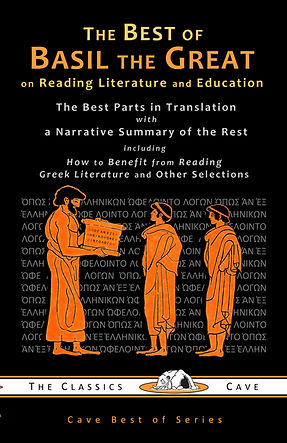
The Best of Basil the Great
on Reading Literature and Education
Think you know about Basil the Great?
Try to answer the quiz questions about Basil the Great found below! Start here.
The Best of Basil the Great
eBook version
$9.95
Coming soon.

Here's what you'll get in reading
The Best of Basil the Great
How should we engage with literature? Many today would tell us to “Just read”—as if that were enough, as if the act of reading in itself accomplishes some good. It increases vocabulary, they would say. It builds cultural literacy. And if nothing else, it exercises the brain, connecting one synapse to another.
“Not so fast!” Basil the Great would protest. It’s all true, what they say. But if we collect all the vocabulary in the world, and become culturally literate superstars, and grow mega brains, and yet we lose our souls, what will have we ultimately gained? Far better, he would counsel, if we read with discrimination and with a clear goal in mind. Far better if we focus on what is truly valuable in order to nourish our souls and become better men and women. Far better if we read in order to act—to do and be well.
In The Best of Basil the Great on Reading Literature and Education, Basil explains how we may do this, how we may read well, carrying on a tradition of critique and counsel that may be traced back to Plato, if not before.
Basil’s guidance influenced countless educators and readers in the centuries to come. Writing mid-twentieth century, the scholar of Greek education Werner Jaeger judged that Basil’s “famous oration on the study of Greek literature and poetry . . . was the charter of all Christian higher education for centuries to come.” We may justly expand Jaeger’s conclusion to read simply all higher education.
So, let’s learn to read with Basil. Let’s do some good for our soul, our inner-most being.
Here's a selection from The Best of Basil the Great
From Chapter One, “The Goal: How to Benefit from Ancient Literature”
THERE ARE MANY considerations that summon me to advise you, young people, on what I judge to be the most excellent things—those things which I am sure will benefit you if you accept them. First, I am able to map out the safest road for those who are just beginning the journey of life. Thanks to my own age, I am in the position to do this since I have already been trained by many experiences and have participated well enough in the all-instructing vicissitudes of life, both good and bad. Consequently, I am experienced in human affairs. Second, inasmuch as I come directly after your parents in natural relationship to you, I myself have for you the same feelings of kindness and goodwill that your own fathers and mothers have. And unless I am utterly wrong in my reading of you, I believe that you do not yearn for your parents when you are with me.
So then, if you eagerly receive my words, you will belong to the second category of men praised by Hesiod. And if you do not—well, I should say nothing unfriendly—so remember for yourselves the passage in which he says, “The best man is the one who sees for himself what must be done. The one who follows the road mapped out by others is also good and noble. But the one who does neither is useless in everything he does.”
Do not be surprised, then, if I say that I have discovered something profitable for you who go to school every day and encounter the famous thoughts of ancient men through the words they have left behind. Here is my advice for you, then: you should not once and for all hand over the rudder of your mind to these men—as one might hand over the rudder of a ship to another—to follow along with them wherever they steer you. Instead, you should accept from them only what is useful and know what to disregard.
From this point on, therefore, I will instruct you in what these useful things are, and how we should go about separating them from the rest.
To read more from Basil, go to The Best of Basil the Great in the Cave Library.
What others have said -
"The Best of Basil the Great . . . is a wonderful book." - Jim
How to Benefit from Reading Greek Literature "is not the anxious admonition of a bigoted ecclesiastic. . . . Rather, it is the educational theory of a cultured man, whose familiarity with classical learning and enthusiasm for it were second only to his knowledge of the Scriptures." - F.M. Padelford
"Basil the Great is excellent in all his works. . . . In the arrangement of and purity of his ideas he is celebrated as a leader, inferior to none." - Photius of Constantinople
Want to read and practice
the best of ancient Greek literature?
pick up the Cave
Best of Series
Want to benefit by reading the best of ancient Greek literature? Want to grow by practicing what you've read? Of course you do! We all do!
In reading a book from the Cave Best of Series, you’ll be reading the best parts of a work in translation—say, Homer’s Iliad or the philosophy of the early Stoics—with a narrative summary of the rest.

The advantage? A Best of Series book makes for a relatively quick read that will let you come to terms with the work—its story and characters, or its discourse, argument, and philosophers—all by yourself.
And you’ll have the opportunity to practice what you’ve read in every book’s Points of Wisdom & Ways of Practice section.


Imagine that! Like the hero Herakles, you’ll be wrestling a lion, as it were, full of good fun, knowledge, wisdom, and ways to go in life.
What you'll get in every
Cave Best of Series book
Not only will you get the best of whatever you're reading, but each book has an introduction explaining why we should care about the author or work, basic facts about the same, and the big themes and ideas of each.
And don't forget the Points of Wisdom & Ways of Practice section that also includes a plan of life following the author or school of philosophy.
Toward the back, you'll find a Cast of Characters, a glossary of pertinent Greek terms (with English equivalents), as well as other matters of interest.
See you inside a Cave Best of Series book!
What do you know?
Quiz Questions for The Best of Homer's Iliad
You'll find the correct answers in the "Quiz Answers" section below (here).
Go here for Quiz Question 1


Quiz Question 2
The Iliad of Homer is about which war? Who fought whom?
A. The Trojan war. The Achaeans fought the Trojans.
B. The Persian Wars. The Greeks fought the Persians.
C. The Peloponnesian War. The Athenians fought the Spartans (Lacedaemonians).
D. The Titanomachy. Zeus (with the offspring of Kronos) fought the Titans.
E. None of the above.
Quiz Question 3
The Iliad of Homer is about which character’s anger? He is angry with whom?
A. The Iliad is about the hero Odysseus’ anger. He’s angry with the suitors.
B. The Iliad is about Telamonian Ajax’s anger. He’s angry with the hero Patroclus.
C. The Iliad is about the hero Achilles’ anger. He’s angry with Agamemnon, the leader of the Achaeans.
D. The Iliad is about the god Zeus’ anger. He’s angry with his wife, Hera.
E. None of the above.
Return to information about The Best of Homer's Iliad here.
What do you know?
Quiz Questions for The Best of Homer's Odyssey
You'll find the correct answers in the "Quiz Answers" section below (here).
Go here for Quiz Question 1


Quiz Question 4
The Odyssey of Homer is about which ancient Greek hero? What is this hero hoping to do?
A. Achilles. This hero is hoping to kill Hector.
B. Odysseus. This hero is hoping to return home.
C. Oedipus. This hero is hoping to discover his real identity.
D. Tydeus. This hero is hoping to conquer Thebes.
E. None of the above.
Quiz Question 5
The following goddess plays the most important role (for a goddess) in the Odyssey of Homer.
A. Athena.
B. Aphrodite.
C. Hera.
D. Demeter.
E. Persephone.
Return to information about The Best of Homer's Odyssey here.
What do you know?
Quiz Questions for Hesiod
You'll find the correct answers in the "Quiz Answers" section below (here).
Go here for Quiz Question 1


Quiz Question 6
The Theogony of Hesiod is primarily about the birth of what?
A. The Theogony is about the birth of the cosmos.
B. The Theogony is about the birth of various Greek heroes.
C. The Theogony is about the birth of the gods.
D. The Theogony is about the birth of various monsters.
E. None of the above.
Quiz Question 7
The Works and Days is a book (or poem) of advice addressed to Hesiod's brother, ________.
A. Theseus.
B. Eumolpus.
C. Perses.
D. Solon.
E. Cambyses.
Return to information about The Best of Hesiod's Theogony & Works and Days here.
What do you know?
Quiz Questions for the Cynics & Cynicism
You'll find the correct answers in the "Quiz Answers" section below (here).
Go here for Quiz Question 1


Quiz Question 8
Who is credited with the founding of Cynicism?
A. Zeno of Citium.
B. Diogenes of Sinope.
C. Crates of Thebes.
D. Chrysippus of Soli.
E. None of the above.
Quiz Question 9
The name "Cynic" comes from the Greek term kuōn or kyōn that means what?
A. Camel.
B. Cat.
C. Dog.
D. Cricket.
E. Cicada.
Return to information about The Best of the Cynics here.
What do you know?
Quiz Questions for Epicurus & Epicureanism
You'll find the correct answers in the "Quiz Answers" section below (here).
Go here for Quiz Question 1


Quiz Question 10
What, for Epicurus, is "the beginning point and goal of life"?
A. Wealth.
B. Victory.
C. Success.
D. Virtue.
E. Pleasure.
Quiz Question 11
What was the name of Epicurus' school of philosophy?
A. The Cave.
B. The Ceramicus.
C. The Walkway.
D. The Porch.
E. The Garden.
Return to information about The Best of Epicurus here.
What do you know?
Quiz Questions for the early Stoics & early Stoicism
You'll find the correct answers in the "Quiz Answers" section below (here).
Go here for Quiz Question 1


Quiz Question 12
Who is credited with founding ancient Stoicism?
A. Zeno of Citium.
B. Chrysippus of Soli.
C. Epictetus.
D. Marcus Aurelius.
E. None of the above.
Quiz Question 13
According to the early Stoics, reason was given to human beings in order to shape what "as a skilled craftsman"?
A. The future.
B. Technology.
C. Philosophy.
D. Impulse.
E. None of the above.
Return to information about The Best of the Early Stoics here.
What do you know?
Quiz Questions for Basil the Great
You'll find the correct answers in the "Quiz Answers" section below (here).
Go here for Quiz Question 1


Quiz Question 14
Basil the Great was the bishop of what city? What was his religion?
A. Rome. Christianity.
B. Constantinople. Judaism.
C. Caesarea. Christianity.
D. Alexandria. Christianity.
E. Ephesus. Judaism.
Quiz Question 15
According to Basil, like ______ and ______, we should gather what is useful from the literature we read.
A. Bees and gardeners
B. Poets and historians
C. Historians and politicians
D. Politicians and poets
E. None of the above.
Return to information about The Best of Basil the Great here.
Quiz Answers
for the 15 Quiz Questions
Quiz Answers
1. D, 2. A, 3. C, 4. B, 5. A
6. C, 7. C, 8. B, 9. C, 10. E
11. E, 12. A, 13. D, 14. C, 15. A
Who wrote the Iliad and Odyssey? Who wrote the Histories? Who wrote the Enneads?
D. Homer. Herodotus. Plotinus.
The Iliad of Homer is about which war? Who fought whom?
A. The Trojan war. The Achaeans fought the Trojans.
The Iliad of Homer is about which character’s anger? He is angry with whom?
C. The Iliad is about the hero Achilles’ anger. He’s angry with Agamemnon, the leader of the Achaeans.
The Odyssey of Homer is about which ancient Greek hero? What is this hero hoping to do?
B. Odysseus. This hero is hoping to return home.
The following goddess plays the most important role (for a goddess) in the Odyssey of Homer.
A. Athena
The Theogony of Hesiod is primarily about the birth of what?
C. The Theogony is about the birth of the gods.
The Works and Days is a book (or poem) of advice addressed to Hesiod's brother, ________.
C. Perses
Who is credited with the founding of Cynicism?
B. Diogenes of Sinope.
The name "Cynic" comes from the Greek term kuōn or kyōn that means what?
C. Dog
What, for Epicurus, is "the beginning point and goal of life"?
E. Pleasure.
What was the name of Epicurus' school of philosophy?
E. The Garden.
Who is credited with founding ancient Stoicism?
A. Zeno of Citium.
According to the early Stoics, reason was given to human beings in order to shape what "as a skilled craftsman"?
D. Impulse.
Basil the Great was the bishop of what city? What was his religion?
C. Caesarea. Christianity.
According to Basil, like ______ and ______, we should gather what is useful from the literature we read.
A. Bees and gardeners
Quiz Answers
1. D, 2. A, 3. C, 4. B, 5. A
6. C, 7. C, 8. B, 9. C, 10. E
11. E, 12. A, 13. D, 14. C, 15. A