
Cave Bonfire Series
Want to know what the ancient Greeks thought and said about a topic?
Find out with one of the following Cave Bonfire Series books.
"I just wanted to say . . . I really love your books! . . . You have really helped me develop myself with your books." - Manuel
$15.95
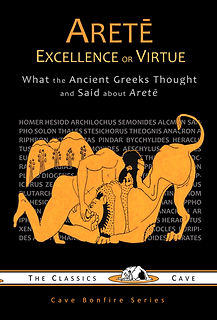

$15.95

To learn more about the Cave Bonfire Series, go here.
To learn more about and read a selection from each book in the Cave Bonfire Series, see the section for each book below (beginning here).
Take a quiz about what the ancient Greeks thought and said about aretē (excellence or virtue) and happiness here.
It's QUIZ time!
Can you answer the following multiple-choice questions?
Look for other quiz questions below.
What to do
Choose the best answer for the questions found here and toward the bottom of this page (here).
You'll find the correct answers in the "Quiz Answers" section below (here).
Quiz Question 1
Which of the following terms may be given to translate the Greek term aretē ?
A. Excellence.
B. Virtue.
C. Success.
D. Valor.
E. All of the above.
You'll find more quiz questions below here.
Aretē: Excellence or Virtue
Think you know what the ancient Greeks thought and said about aretē?
Try to answer the quiz questions about aretē below! Start here.

Aretē: Excellence or Virtue
eBook version
$9.95
Coming soon.

Here's what you'll get in reading
Aretē: Excellence or Virtue
Have you ever wondered what it means to be great? Excellent or virtuous? If so, then you’ll want to hear what the ancient Greeks had to say about excellence or virtue since they thought and said a lot about it.
Aretē: Excellence or Virtue is a book that systematically presents what ancient Greek poets, historians, orators, and philosophers thought and said about the nature of excellence or virtue (what they termed aretē ), all in their own words.
And what did they say? In Homer’s Iliad, Achilles’ father urges him to “be the best”—that is, to possess aretē, excellence or virtue. In the Odyssey, old Laertes rejoices that his son, Odysseus, and his grandson, Telemachus, are “battling over aretē.” Hundreds of years later, the poet Theognis of Megara counseled his friend to “wear himself out for the sake of aretē.” Still later, the philosopher Socrates spent time with anyone who would talk with him about what it meant to cultivate aretē. And that’s only the beginning of a conversation that lasted for well over a thousand years.
That everyone in the ancient Greek world wanted to have and practice aretē is without doubt. It’s what they hoped, prayed, and struggled for. It’s what they admired and rewarded. The Spartan poet Tyrtaeus expressed the common view when he declared that aretē was the “best and noblest prize” one could win.
Still, a question remains. As valuable as aretē was to them, what did the ancient Greeks mean by it? The goal of this book is to let them answer.
After a brief introduction exploring the meaning of aretē and situating it in a more contemporary context, Aretē: Excellence or Virtue presents what the ancient Greeks thought and said about aretē in their own words. We follow poets, playwrights, and historians on the what, who, and how of aretē. We listen to what all the major philosophers and schools of philosophy taught. And, finally, we hear selected passages from a number of orators that touch on aretē.
No matter how you peruse Aretē, you will likely find your own views on human excellence and virtue shift as the Greeks influence your thinking about and even pursuit of aretē.
Plus, you’ll have an opportunity to practice aretē by following “A Plan of Life Aimed at Aretē ” and engaging in the workbook and journal-like practice exercises found toward the end.
More, in the glossary, you’ll discover Greek terms that are pertinent to aretē. Lastly, you’ll be pointed in the direction of further reading.
What now? Grab a copy of Arete: Excellence or Virtue and see for yourself what the ancient Greeks have to say. We at the Cave believe your life will be enriched by doing so.
Here's a selection from the very beginning of Aretē: Excellence or Virtue
From the Introduction
The Greek word for “best” is aristos, a word found in the English word “aristocracy” (the rule of the best, the noblest) and in the name of Aristotle (one of ancient Greece’s outstanding philosophers). Aristos itself is a word that originally meant “most fitting,” from the suffix -isto-, signifying the superlative, and the root ar-, “to fit together,”—as when an expert builder joins two walls together well or a shipwright the parts of a ship or a poet the elements of a poem. In the ancient world, therefore, to be aristos was to be the most fitting kind of thing. As for humans, it was to be the “noblest, bravest, most virtuous, and most excellent” kind of human being.
Related to aristos is the Greek word aretaō, a word that means “to be fit or proper, to thrive, prosper, flourish.” What sort of things do so (aretaō)? Good deeds thrive (we are told by Homer). Fields flourish with grain (we see elsewhere in Greek literature). And humans prosper and thrive and flourish (as we also observe in the same).
This—the meaning of aristos and aretaō for humans—brings us to aretē, the subject of this book.
In Their Own Words
The Greeks Speak about Aretē - Excellence or Virtue
(the source for the quote is in italics )
Homer (Nestor is speaking) “Old Peleus enjoined his child Achilles to always be the best and to stand out among other men.”
Bacchylides of Ceos I declare—and I will declare—that the greatest glory is to possess excellence.
Sophocles The only secure acquisitions are those tied to excellence.
Isocrates Excellence, when it grows up with us in our hearts without alloy, is the one possession that abides with us in old age.
Aristotle The human good, then, is the activity of the soul that accords with virtue. And if there happens to be more than one human virtue, then it is that activity which accords with the best and most complete or perfect virtue.
Diogenes Laertius In his work On the Nature of Man, Zeno [of Citium] was the first to say that the end or goal of life is to live in accord with nature, which is the same as living in accord with virtue, since nature leads us toward virtue.
Xenophon Socrates openly tried to reform young men and exhorted them to desire the most noble and magnificent virtue by which men prosper in public life and in their homes.
Plato (from the Republic) Socrates: Virtue is the means by which a thing performs its function well. . . . The function of a thing is that which it alone can do, or what it does better, than anything else.
Socrates: Will the soul be able to perform its own function well if it is lacking its own virtue? Or will it be unable?
Thrasymachus: Unable.
Socrates: Necessarily, then, a bad soul rules and manages things badly, and a good soul does everything well?
Thrasymachus: Necessarily. . . .
Socrates: But he who lives well is blessed and happy.
Aristotle We have now discussed the common properties of the [moral] virtues. We’ve looked at an outline of their general nature—that they are means that fall between two extremes, and that they are habits, which is to say a trained ability or disposition. Further, we’ve shown that the virtues render us apt to do the same actions as those by which they are produced, and to do them in a manner commanded by right reason, and that the virtues depend on us and are voluntary.
Aristotle We acquire the [moral] virtues . . . by doing them, by putting them into action, just as we do with the various arts or skills. For we learn an art or skill by doing that which we wish to do when we have learned it. We become builders by building and harpers by harping. And so, by doing just acts we become just, and by doing acts of moderation and courage we become moderate and courageous.
Diogenes Laertius (presenting the Stoic view) Among the virtues some are primary, and some are subordinate to these. The following are the primary virtues: practical wisdom, courage, justice, and moderation. . . . Similarly, among the vices, some are primary, and some are subordinate. Folly, cowardice, injustice, and immoderation are primary. The vices are ignorance of those things of which the virtues are the knowledge.
The above is the just the beginning. Read Aretē to find out what else the Greeks thought and said.
What others have said -
Arete (Excellence or Virtue) "is an extraordinary exploration of ancient Greek philosophy that profoundly deepened my understanding of the ancient world and its timeless principles. [It is] an indispensable guide for anyone passionate about history, ethics or self-improvement. A must-read for scholars and seekers alike!" - Alex
Aretē (Excellence or Virtue) is "an excellent compilation that fills in the corners and crevices often overlooked in defining this profoundly useful and inspiring concept. I thought I needed this book so that I could better explain it to my students but came to realize this is essential nourishment for my own soul."—Anonymous Amazon Customer
Arete (Excellence or Virtue) is a "very well written look at what excellence meant to various ancient Greeks. Was having trouble putting it down." - Steve
Happiness
Think you know what the ancient Greeks thought and said about happiness?
Try to answer the quiz questions about happiness below! Start here.

Here's what you'll get in reading
Happiness
Have you ever wondered what happiness is? What it means to be happy? If so, then you’ll want to hear what the ancient Greeks had to say about happiness since they thought and said a lot about it.
Happiness is a book that systematically presents what ancient Greek poets, historians, orators, and philosophers thought and said about the nature of happiness, all in their own words.
And what did thy say?
Go into the papyrology room of the Sackler Library at Oxford University and you’ll find a remarkably small scrap of papyrus that is a tiny fraction of a poem by the sixth century BC Greek poet Stesichorus. Its sloppily written script announces something very large relative to its small size. After obliquely referring to Ares, Athena, and another god, the mostly all-caps fragment tantalizingly declares, “HAPPY THE MAN WHO . . .” before unhappily ending in a jagged tear that demands we eagerly ask, Happy the man who what ?! Who is the happy man or happy woman?
It's a question the ancient Greeks long pondered from Homer to Plotinus, with countless poets, playwrights, historians, orators, philosophers, and others offering answers during the thousand years in between.
That happiness was the goal of life, few Greeks doubted. Rather, the big debate centered on the nature of happiness—what happiness is and how we humans can be happy.
After a brief introduction, Happiness presents what the ancient Greeks thought and said about happiness, all in their own words. You’ll get the scoop on who was happy and how, and discover happy places and times. You’ll hear prayers for happiness, take in brief happiness formulas, and contemplate the ideas all the great philosophers had about happiness.
Finally, if you choose to, you’ll have a chance to practice happiness in response to the ancient Greek philosopher Epicurus’ insistence that “we must practice those things that produce happiness.”
There’s more, of course. But we’ll let you discover what it is within the pages of Happiness. See you inside.
Happiness
eBook version
$9.95
Coming soon.
Here's a selection from the very beginning of Happiness
After an introduction including an exploration of the term “happiness” and contemporary ideas about the same, Happiness transitions into eighteen chapters presenting what the ancient Greeks thought and said about happiness. Here’s a bit of what they had to say . . .
In Their Own Words The Greeks Speak about Happiness (the source for the quote is in italics )
Plotinus Being happy is the supreme end to which all nature aspires.
Aristotle Happiness is the goal of human life.
Julian (the Roman emperor) The aim and end of . . . every philosophy is to be happy.
Epicurus Let no one put off studying philosophy when he is young, nor become weary of it when he is old, for no age is too early or too late for the health of the soul. To suggest that the time for studying philosophy has not yet come or that it is long gone is like saying that it is too early or too late for happiness. . . . We must practice those things that produce happiness since if happiness is present, we possess everything, and if it is not, we do everything to acquire it.
Archytas What goods are naturally desired for themselves and not for anything else? Evidently they include happiness since happiness is the end for which we seek everything else, while we seek happiness only for itself and not for anything else.
Eusebius of Caesarea Aristippus was a companion of Socrates and the founder of the so-called Cyrenaic school. . . . His life was entirely luxurious, and he was fond of pleasure. . . . He used to say that the essence of happiness is found in pleasures.
Epicurus (Letter to Menoeceus) We say that pleasure is the beginning point and goal of living happily. We recognize that pleasure is our first good. . . . When we say that pleasure is the beginning point and goal of life, we do not mean the pleasures of decadent men or the pleasures of sensuality, as some ignorant persons believe, or those who do not agree with us, or those who have willfully misrepresented our position. Rather, by pleasure we mean the absence of pain in the body and of trouble in the soul.
Aristotle Since all knowledge and moral choice aims at good of one kind or another, . . . the question is this : what is the highest good that action can achieve? As for its name, nearly everyone is agreed—for both the crowd of men and the few who are educated and refined call it happiness, and they assume that “living well” and “doing well” is the same thing as “being happy.” But they argue about what happiness is. The account given by the many is not the same as that given by the wise. Most people associate happiness with obvious things that can be seen and felt, such as pleasure or wealth or honor. . . . But quite often the same man declares happiness one thing and then another—health when he is sick and wealth when he is poor.
Aristotle To call happiness the highest good is perhaps to speak in terms of clichés. Therefore, what we need is a clearer account of what, exactly, happiness is. It is possible we will be able to do this when we have ascertained man’s proper function. . . .
What can this function possibly be? Can it be living itself? No, life and the act of living is clearly something that men have in common with plants—and what we are seeking is something that mankind alone does. Let us therefore eliminate the life-act of nutrition and growth. The next possibility is sense perception, that is, some form of perceptive living or life. But this form of living also seems to be something common to horses, oxen, and every other animal. There remains, then, a kind of active or practical life that follows reason or some rational principle. . . .
Therefore, man’s proper function or work is an activity of the soul in accordance with reason—at the very least not independent of reason. . . . And the function of an excellent man is to perform these activities well and rightly. . . . The human good, then, is the activity of the soul that accords with virtue. And if there happens to be more than one human virtue, then it is that activity which accords with the best and most complete or perfect virtue.
Diogenes of Sinope I came, Father, to Athens, and learning that Socrates’ associate was teaching about happiness, I went to him. And he happened to be speaking about the paths that lead to happiness. He declared that there are two and not many paths—and that one is a shortcut and the other is long. . . . The one is short, steep, and troublesome; the other is long, smooth, and easy. . . . While the others, who were struck with fear at the troublesome and steep nature of the one path, called on him to lead them along the long and smooth one, I, superior to the hardships, chose the steep and troublesome path—for the man speeding on to happiness must go on even if it is through fire and sword.
Diogenes Laertius The Stoics hold that virtue is sufficient in itself to ensure happiness. . . . Happiness consists in virtue, which is the state of the soul that tends to make the whole of life harmonious.
The above is the just the beginning. Read Happiness to find out what else the Greeks thought and said.
Want to know what the ancient Greeks thought and said about a topic?
Topics such as aretē, happiness, desire, pleasure and pain, the human condition, friendship.
Pick up a book from the Cave
Bonfire Series
The Cave Bonfire Series gathers together what the ancient Greeks felt, thought, said, and sometimes did relative to a topic important to us human beings.
The result? Like a great bonfire constructed of sticks and logs, some hefty and substantial, some not as much, each volume presents what the ancient Greeks thought and said about a topic, all in their own words, with narrative transitions in between.

Beginning with Homer and Hesiod, the earliest Greek literature we have from the late 700s BC, and ending with those writing toward the collapse of the ancient world some one thousand years later, the Cave Bonfire Series blazes before the reader with the light of each source relative to the topic.

What else will you get in every
Cave Bonfire Series book?
Not only will you get what the ancient Greeks thought and said about a topic, but there is an introduction that situates the topic relative to contemporary thought and life, as well as a conclusion that summarizes and further reflects on what the Greeks thought and said.
And don’t forget that with each Cave Bonfire Series book, you’ll have a chance to practice what you’ve read in the Points of Wisdom & Ways of Practice section that also includes a plan of life relative to the topic.
Finally, toward the back there is a glossary of pertinent Greek terms with English equivalents, as well as suggestions for further reading.
See you inside a Cave Bonfire Series book!
What do you know?
Quiz Questions for Aretē
You'll find the correct answers in the "Quiz Answers" section below (here).
Go here for Quiz Question 1

Quiz Question 2
Which of the following ancient Greek philosophers held that "virtue is the means by which a thing performs its function well," where "the function of a thing is that which it alone can do, or what it does better, than anything else." For instance, this same philosopher held that the function of the rational part of the soul is to rule and direct the whole soul. It does so, he said, by means of wisdom, its virtue.
A. Plotinus.
B. Diogenes of Sinope.
C. Plato.
D. Aristotle.
E. None of the above.

Quiz Question 3
According to many ancient Greek philosophers, the four cardinal virtues are wisdom, courage, moderation, and _______________.
A. Goodness.
B. Justice.
C. Temperance.
D. Magnanimity.
E. Self-control.
Return to information about Aretē here.
What do you know?
Quiz Questions for Happiness
You'll find the correct answers in the "Quiz Answers" section below (here).
Go here for Quiz Question 1

Quiz Question 4
For most ancient Greeks, happiness is . . .
A. The goal of life.
B. A good feeling furnished by Fate.
C. Something money can buy.
D. Identical with bodily pleasure.
E. None of the above.
Quiz Question 5
Which of the following ancient Greek philosophers held that "happiness is an activity of the soul that accords with perfect virtue."
A. Epicurus.
B. Aristippus of Cyrene.
C. Aristotle.
D. Heraclitus of Ephesus.
E. Parmenides of Elea.
Return to information about Happiness here.

Quiz Answers
for the 5 Quiz Questions
Quiz Answers
1. E, 2. C, 3. B, 4. A, 5. C
Which of the following terms may be given to translate the Greek term aretē ?
E. All of the above.
Which of the following ancient Greek philosophers held that "virtue is the means by which a thing performs its function well," where "the function of a thing is that which it alone can do, or what it does better, than anything else." For instance, this same philosopher held that the function of the rational part of the soul is to rule and direct the whole soul. It does so, he said, by means of wisdom, its virtue.
C. Plato.
According to many ancient Greek philosophers, the four cardinal virtues are wisdom, courage, moderation, and _______________.
B. Justice.
For most ancient Greeks, happiness is . . .
A. The goal of life.
Which of the following ancient Greek philosophers held that "happiness is an activity of the soul that accords with perfect virtue."
C. Aristotle.
Quiz Answers
1. E, 2. C, 3. B, 4. A, 5. C